

In November, I spent three weeks in Morocco to prepare my next research project. The prospect of working ethnographically in Morocco for the next years is a huge motivation to take my Arabic skills to the next level. Although I am an experienced language learner, I have really struggled to put my Arabic into practice. This time, I took a course in Moroccan Arabic which proved to be a different and more rewarding experience than my previous struggles with Classical Arabic, or so-called Modern Standard Arabic.
15 years of Arabic learning
I started learning Arabic during my BA in Berlin where I enrolled in a major that is called somewhat misleadingly „Islamic Science“ in many German universities. In fact, we didn’t learn much about Islam per se and more about all sorts of topics prevalent in Muslim (and most other) societies, as diverse as Indonesia, Syria and Egypt. At that time the „Arab Spring,“ was all over the news and I just wanted to learn non-European languages – so, these studies seemed interesting.
To my delight, Arabic classes were the major component of my first two years at university. We studied as a group of about 20 students for two hours four days a week. There weren’t any more intensive language courses at any university where I studied or worked. After completing the course, students of my program were supposed to know enough Arabic to carry out their studies about topics in the Arab world. I could listen to and read news media in Arabic and – with some preparation – have staged discussions about political and academic topics. However, I couldn’t even start ordinary conversations with any Arabic speakers. When I went the first time to Morocco, I had to resort to French to buy a bottle of water because the shop owner couldn’t make sense of my Arabic. Not being able to communicate in a language that I had learned enthusiastically for two years felt very frustrating.
Why is Arabic hard?
As a linguist, I am confident that Arabic is not much harder than most languages. Of course, you have to learn a different script, but this is only a superficial hurdle. Arabic phonology is different from European languages – e.g. it has pharyngeals, consonants that you need to produce with some part of your throat – but there are certainly languages which are more difficult to pronounce. Arabic has a rich morphology which means that nouns and verbs can appear in many different forms with slightly nuanced meanings. There is an underlying beauty to this logical system – to me it seems like the grammar works like a mathematical function. In my opinion, these structural differences to European languages don’t make the language hard to learn.I found out that what’s most complicated for many Arabic learners is its context of use.
The useless beauty of fusha
Arabic speaking societies have been described as diglossic (Ferguson 1959). This means that two varieties like dialects of the same language are used in different contexts. For example, in Switzerland which was one of Ferguson’s examples, Swiss German dialects are used for most spoken contexts, except for somewhat staged or formal situations, like parliamentary debates, university lectures where most would speak Standard German. Curiously, in „the Arabic speaking world,“ except for news anchors and Islamic religious authorities, almost nobody speaks the language that is taught in Arabic courses – so-called Modern Standard Arabic, classical Arabic, or fusha. This type of Arabic is nobody’s first language – it has to be learned in formal settings like schools even by Arabic speakers. For all their daily business, Arabic speakers use their local Arabic dialect or other languages like French or English.
It is understandable, that countries like Egypt and Morocco uphold Arabic as their official language for ideological reasons that may be politically and religiously motivated (see Pan-Arabism). In reality, Arabic is nobody’s first language and most Moroccans and Egyptians would rather use English than Arabic to communicate with each other. To draw an analogy, Portuguese and Italians would also switch to another common language, instead of having half the conversation in Portuguese and the other half in Italian. What I still don’t get is why millions of language learners have to learn a variety that is little more useful in modern life than Latin. When you learn Latin though, it is more likely that you are aware that you wont be able to talk to or understand anyone in Italy or Spain.
Learning Arabic the better way
Instead of learning Standard Arabic, you can also learn a spoken variety of Arabic, like Egyptian or Moroccan Arabic. With these varieties you wont be able to communicate with everyone from „Arab countries,“ but having real conversations with people from one country will be satisfying. Usually, some basic courses of Arabic dialects are taught at universities. Of course, the better option is to learn a language where it is spoken. Learning Moroccan Arabic has not been very popular compared to other dialects, but there are good reasons to choose this variety.
In Morocco, there are only a few schools that offer courses in (Moroccan) Arabic. One of them is Qalam wa Lawh which is located in Morocco’s capital city Rabat. Qalam is open to everyone who wants to enroll, but it targets mostly American and European university students. The school is located in a fancy neighborhood and offers all amenities (food, housing, excursions) that you may need during your stay for reasonable prices.
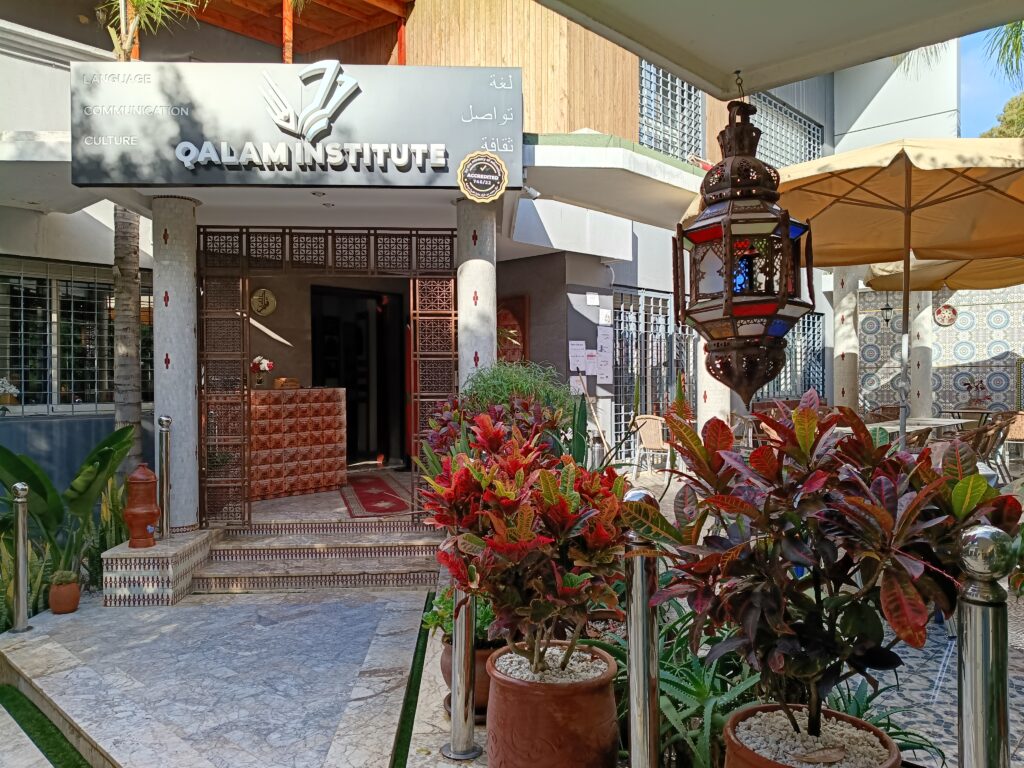
I learned Moroccan Arabic for two weeks with a group of 5 students every morning and booked some private classes for the afternoon. Regular group courses also include free tutoring lessons with a teacher which give you the chance to revise and talk. In general, there aren’t many teaching materials for Moroccan Arabic. At Qalam they use this free book which was published by the American Peace Corps and they have created some of their own materials.
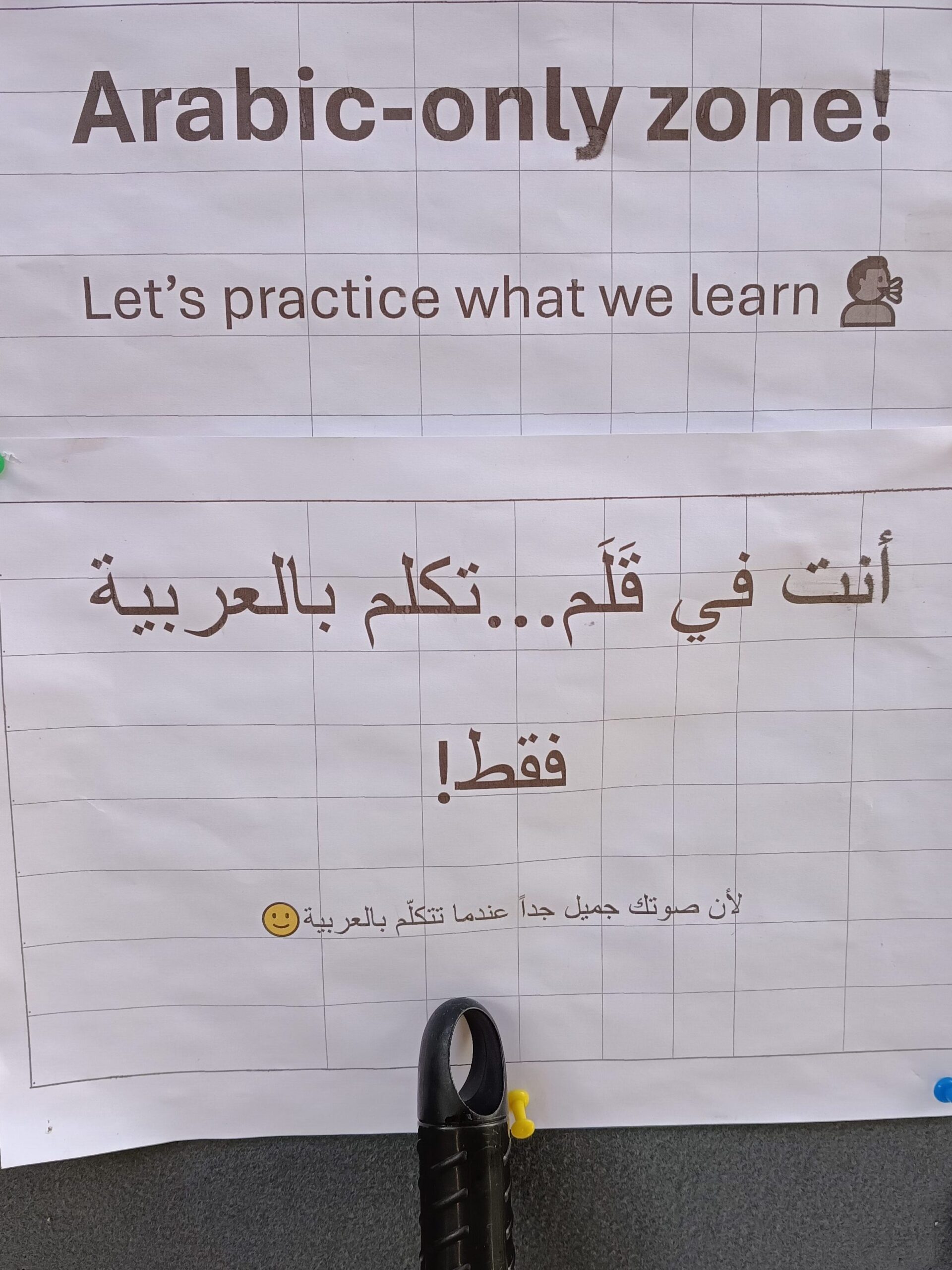
What I really liked about the group courses is the amount of time we spend talking. For the private lessons, my teacher Samah put a lot of effort into helping me to prepare materials for my research project. Essentially, we practiced explaining my project and worked on texts that I will use during fieldwork. Overall, I was very happy with the experience and progressed a lot in a short time. However, learning an unstandardized spoken language has its own challenges and after all it still is Arabic…
Linguistic uncertainty
For example, I often have trouble looking up Arabic words because there are usually many options. In our language course we wondered how to say ‚being sad‘ in Moroccan Arabic. Our teacher translated it to مقلق mqlq which can also mean ‚being angry.‘ Some of us argued that ‚angry‘ and ’sad‘ are quite different. You can probably imagine conversations going wrong because of misunderstandings.
Another huge challenge for me is that in many cases I cannot imagine appropriate contexts. For example, it might be the case that you simply don’t talk that much about being sad or being angry in Morocco. From my experience, Moroccans instead tend to beat around the bush and rather downplay their problems by joking or invoking the help of Allah. This could explain why it may seem irrelevant to distinguish between anger and sadness with separate words: the feeling of unease and probably the causes for the feeling may be common to both, one may argue. I am making this impressionistic observation as mere language user and not as linguist.
To end with something properly linguistic: The phenomenon that two concepts are referred to with the same lexeme, i.e. word, is called colexification. In our example, ‚being angry‘ and ‚being sad‘ are colexified as mqlq in Moroccan Arabic. I find research about different types of colexifications in different languages fascinating and I like to wonder about the evolutionary and cognitive causes (see Karjus et al. 2021).
References
Ferguson ,Charles A. (1959), Diglossia, WORD, 15:2, 325-340, DOI:
10.1080/00437956.1959.11659702
Karjus, A., Blythe, R.A., Kirby, S., Wang, T. and Smith, K. (2021), Conceptual Similarity and Communicative Need Shape Colexification: An Experimental Study. Cognitive Science, 45: e13035. https://doi.org/10.1111/cogs.13035
Schreibe einen Kommentar