
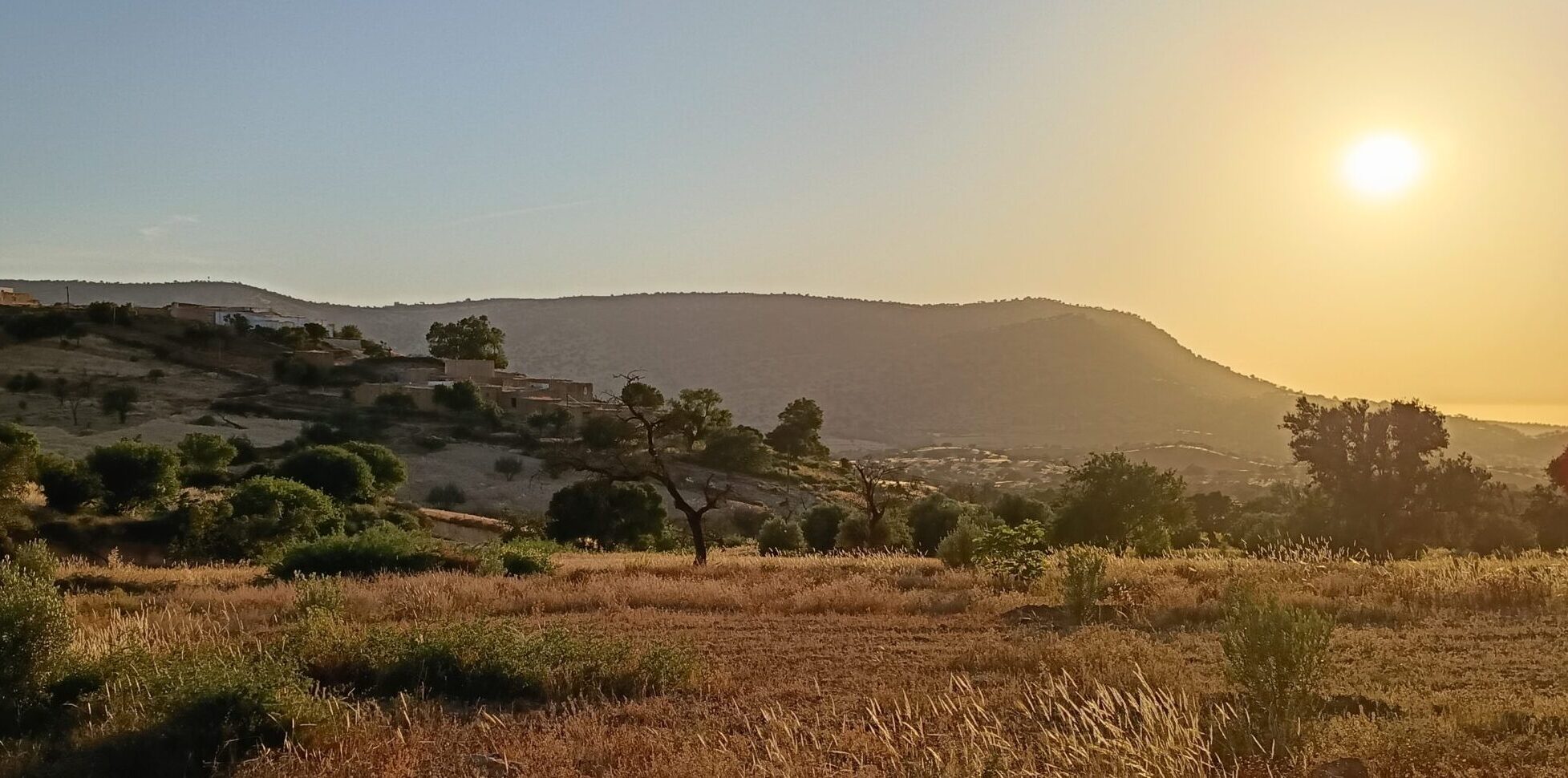
In my research project Investigating cognitive diversity through landscape language, I analyze how Moroccans talk and think about landscape. To get a feeling for the context of my research topic and to collect data that I will analyze, I just spent more than 5 weeks in Morocco for „fieldwork.“ Here, I will describe what I did, share four highlights (HL) and reflect on my experiences.
The purpose of fieldwork
When linguists or social scientists talk about „fieldwork“ they usually don’t refer to any physical work like plowing and normally they don’t spend time on fields. The term is used metaphorically to refer to contexts outside offices, laboratories and universities where scientists try to observe what is going on in the real world between real people. Depending on the research domain, the „field“ that scientists study can be anything from classrooms, prisons, companies or indigenous communities. The scientists‘ „work“ in these places typically involves hanging out, observing, talking to and recording peoples‘ activities. They might also measure certain phenomena and carry out experiments.
Tricky aspects
Fieldwork can be problematic because typically a privileged scientist enters an unfamiliar context and tries to gather information. Luckily, there is a whole research domain dedicated to questions of how to conduct fieldwork in ethically responsible and beneficial ways. Over the last decades legal aspects e.g. about data protection and privacy have been gaining prominence. To get the green light for my study, I had to pass an institutional review at the University of Chicago where I work. This meant that I had to explain in detail what I was going to do in Morocco. The institutional review board gave me an additional incentive to design my research to comply with ethical and legal standards.
On a personal level, fieldwork is inherently challenging. For typical linguistic fieldwork, you find yourself amongst strangers trying to master a foreign language on the spot, and learning as much as possible about cultural and social phenomena . While navigating in unfamiliar surroundings, you have to keep track of your research goals in order to return to the office with some kind of analyzable data. Essentially, you need to appear interesting enough for locals to be able to talk to them, recruit some study participants and ideally to build lasting relationships. Because all of this is very tricky, I always found it incredibly rewarding and exciting if my unlikely plans partly worked out. What’s especially great about fieldwork is „everything what happens, while you’re busy making […] plans“ (in John Lennon’s words). I picked out four highlights from my latest experience to give you an impression.
HL1 Being outdoors
Because my study revolves around landscape, I was lucky enough to spend time in actual fields. My research area is located in Southern Morocco between Essaouira and Agadir.
The region is called Iḥaḥan in the local language Tashelhit and is well known for its rough arid hills which are covered by Argan trees that grow almost nowhere else in the world (see the photo above). Beneath the trees local Amazigh people plant barley, some other crops and vegetables where possible and herd sheep and goats which climb Argan trees to feed off their leaves and fruits.
zayd a’yxf-inu s Iḥaḥan dar id bu-tamment (El-Mountassir 2019:176)
‚Lets go to Ihahan, land of honey‘
To document how locals talk and think about landscape, I recorded outdoor conversations about landscape. With Ali, my local contact and assistant (see below), I recorded with more than 25 participants. We met them at their home, at work or at a place which was significant for them. In practice we used two GoPro cameras and microphones to capture participants‘ perspectives, their voices and GPS coordinates while walking.
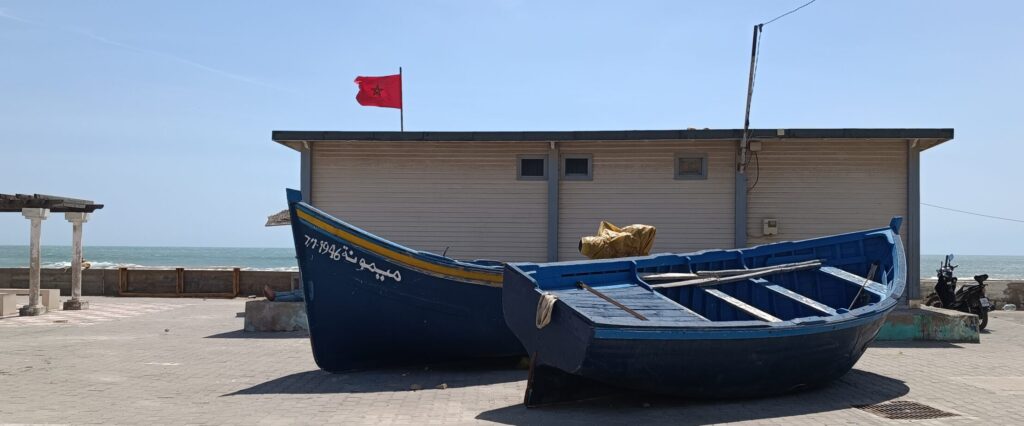
Thus, I discovered remote valleys, mountain tops, beach towns and their inhabitants‘ ways of life. I enjoyed spending so much time outdoors and developed a sense of place for my research area. One of my favorite moments was talking to a shepherd. In less than an hour we had to rescue two little goats who got trapped between branches, when they fell off an Argan tree. I didn’t know that shepherding involves so much action and goats are so irresponsible climbers.
HL2 Tajines and seafood
Being outdoors made us hungry, so we combined most of our data collections with culinary expeditions. When we went to the small fisher and surfer village Tafedna, we concluded our interview with a fisherman with delicious seafood.
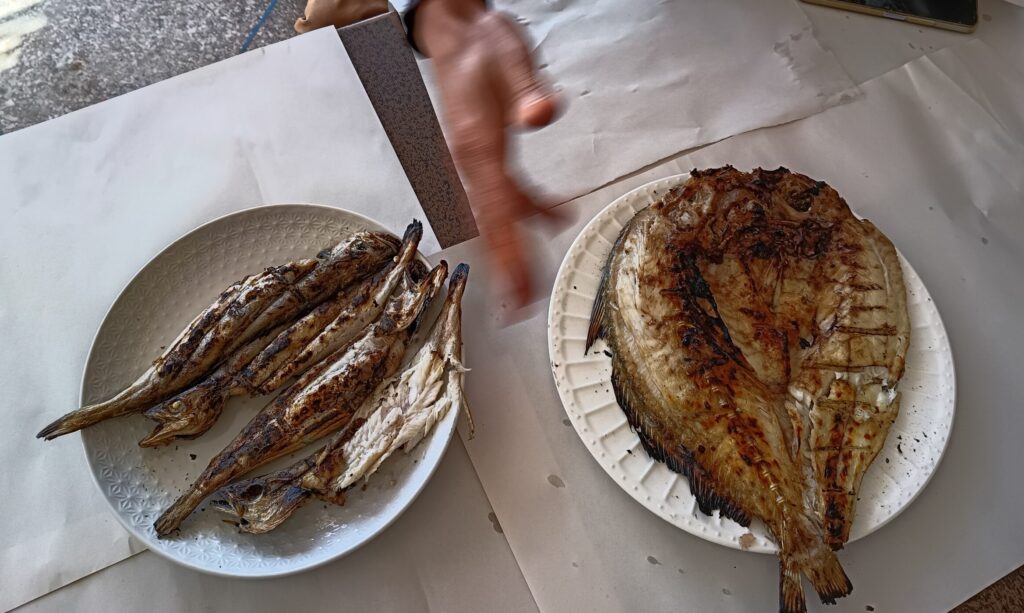
We also bought a giant fish that we shared with friends back home in the form of two delicious Tajines (see photo below).
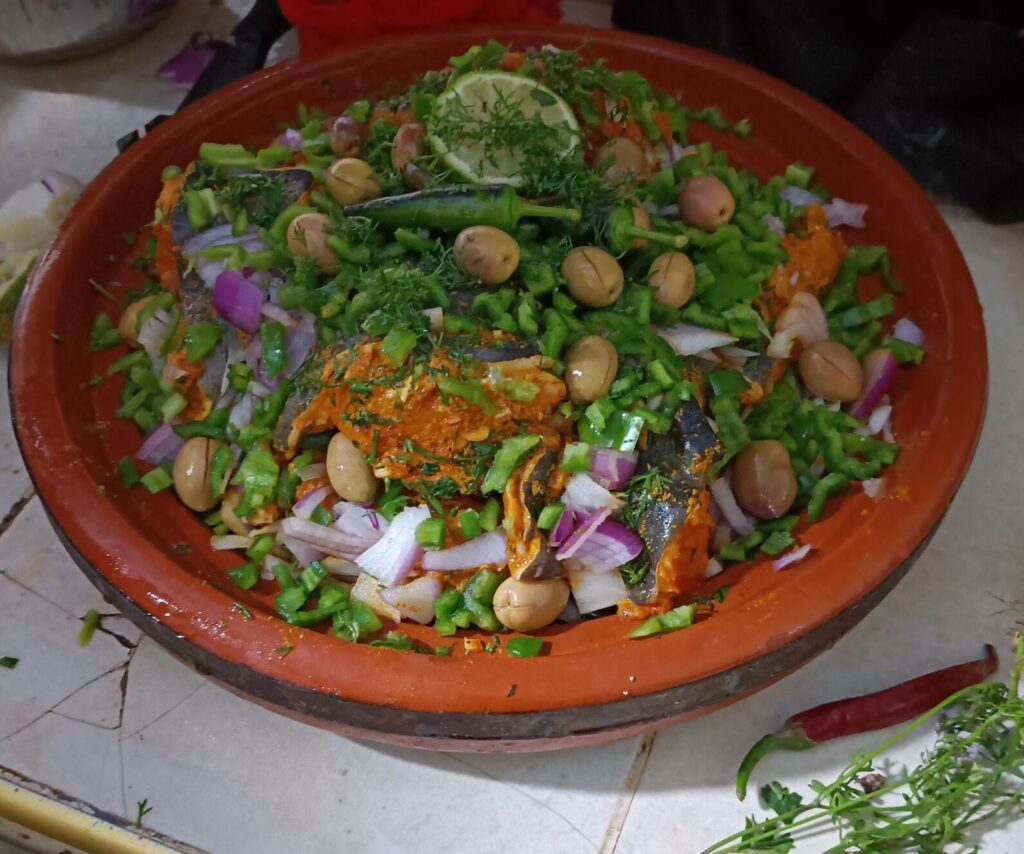
Tajine is the most common food you can find in villages in Morocco. Usually, simple kitchens at the roadside offer different sorts of meat with vegetables or dried fruit that cooked slowly in a covered earthenware pot (i.e. the Tajine). Occasionally, I found out that you can even take out the whole Tajine, enjoy it e.g. on a mountain top and return the pot later.
HL3 Amazigh Music
I found out that music plays a huge role in the region. Traditionally, it has been important for transmission of poetry (amarg) and cultural values. On our outings we took instruments that were played outdoors and even in the car. Once we went to a tadakir which was a festival to honor Moulay Hmad Ihihi, one of the most famous rways of the region. A rais is a band leader who is respected for his worldly wisdom that he acquired through his journeys. The video below is from Larbi Ihihi who also performed at the event. Characteristic Amazigh instruments are theribab, a sort of violin with one string, lutar which is like a lute and allun a tambourine.
Amazigh music is very rhythmic and melodic and has the potential to stick to your head forever. The genre is similar to better known Tuareg artists like Tinariwen and Bombino. Superstars like Robert Plant from Led Zeppelin, and allegedly the Beatles and Jimi Hendrix, have been inspired by this style of „desert blues“.
HL4 Patience, trust and friendships
During fieldwork I also learned a lot (maybe primarily) about myself. It was a unique chance to train essential skills which are very handy, but notoriously hard to master, like building patience, trust and friendships.
A big component of fieldwork is hanging out together – an activity which easily gets neglected in fast-paced societies. But, as the following Amazigh proverb expresses, some things cannot be hurried:
Imik s imik ar ikššm aram s ugdu (Peacecorps p.88)
‚Little by little the camel enters the pot‘
Above all, I am thankful for the many personal encounters and the time that we could spend together. The most important person during my time in Morocco was Ali who supported me in many ways and became a friend. Ali is an artist/architect, musician and café owner. You can visit him at Akal café in Tidzi which is marked on the map above.
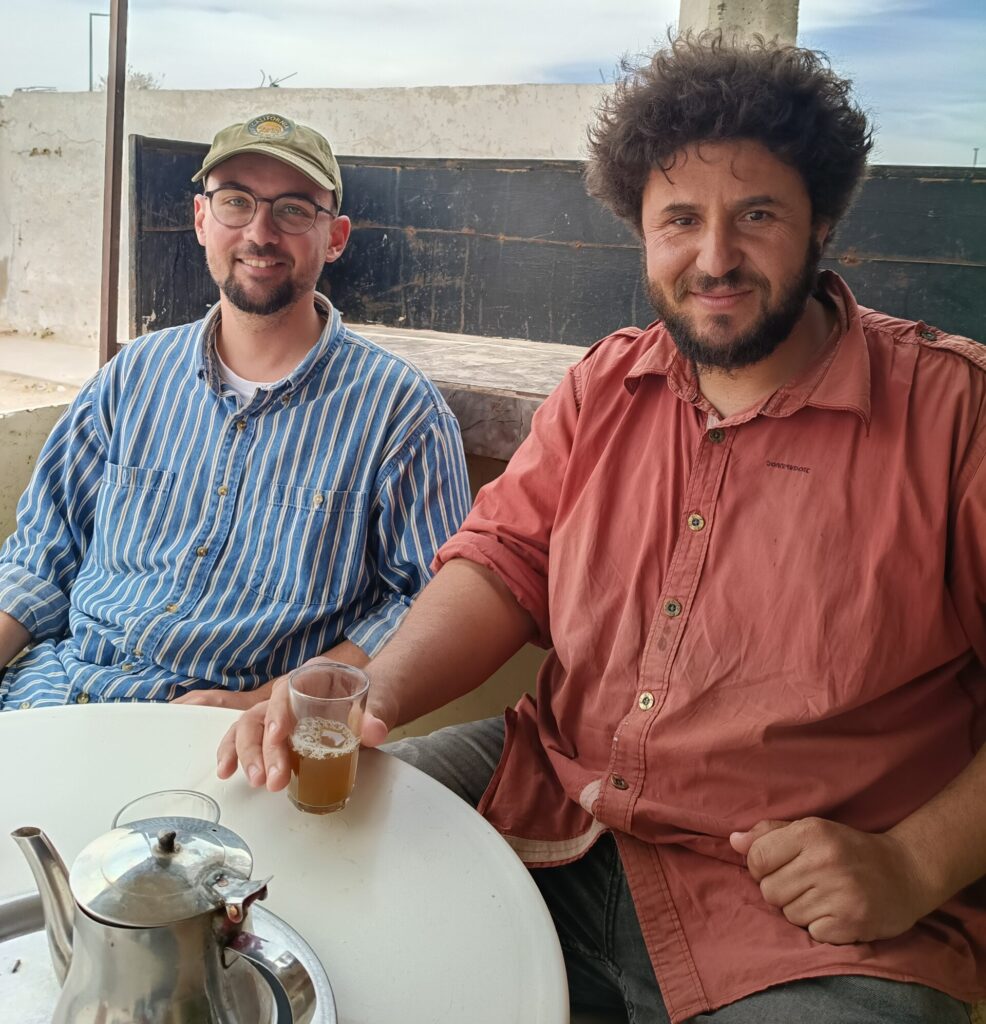
Finally, some condensed fieldwork wisdom: If you trust people you will be surprised how helpful and friendly they are and how much they are willing to do for you. Even if trust doesn’t lead to collaboration or friendship, it is worth the try and most likely both parties had the chance to learn something.
Further reading:
Tashelhit peacecorps text book
Encyclopaedic knowledge about Ihahan
Mountassir, Abdallah El. 2019. Langue, culture et territoire dans le Souss. Faculté des lettres et des sciences humaines d’Agadir.
Schreibe einen Kommentar